International food blog: INTERNATIONAL GREECE: Part 2 - Griko cuisine me...: Greek presence in Italy begins with the migrations of the old Greek Diaspora
Translate
Showing posts with label griko. Show all posts
Thursday, July 8, 2021
International food blog: INTERNATIONAL: GREECE: Part 2: Griko cuisine meets Italian...
INTERNATIONAL: GREEK - Part 2 B : Greece in Italy!!! Salentina and Bovesia
THERE ARE TWO GREEK-SPEAKING COMMUNITIES IN ITALY!!!
---------------------------------------------------
RECIPES FOR GRIKOS FOOD BELOW GENERIC GREEK FOOD PHOTOS
A cut and paste from Wikipedia about Food
Cuisine (Click on GRAY WORDS to learn more)
The traditional cuisine of Salento and Calabria has been heavily influenced by Griko culture. The Griko are traditionally producers of cereals, vegetables, olives and legumes.[86] Local Griko cuisine does not differ greatly from the local Italian population, however there local regional variations. Many typical Griko dishes are still in use among them. Some of them are mentioned below.
- Pitta and Lestopitta - a traditional Greek-Calabrian bread from the Bovesia region
- Ciceri e ttrìa - A form of Tagliatelle served with chickpeas. Traditionally this dish was consumed on the feast of Saint Joseph on 19 March in Grecia Salentina.
- Cranu stompatu - a wheat dish, prepared in a simple way, by soaking and pounding the wheat
- ricchiteddhe - type of macaroni
- minchiarieddhi - a type of long macaroni
- sagne ncannulate - a wide tagliatelle up to inch and a half
- triddhi - irregular shaped pasta, specifically used for making Broth
- Mendulata te cranu - a dessert similar to Pastiera, filled with cream cheese, honey, sugar and vanilla
- Le Cuddhure - a traditional Griko cake made during Easter, from the Greek Koulouri
- Tiaulicchiu - Hot Chili peppers, extensively eaten throughout Grecia Salentina, they are usually stored dry, or preserved in jars of oil, with the addition of slivers of garlic, mint, and capers
- Sceblasti - a traditional type of hand made bread from the Grecia Salentina region.[86]
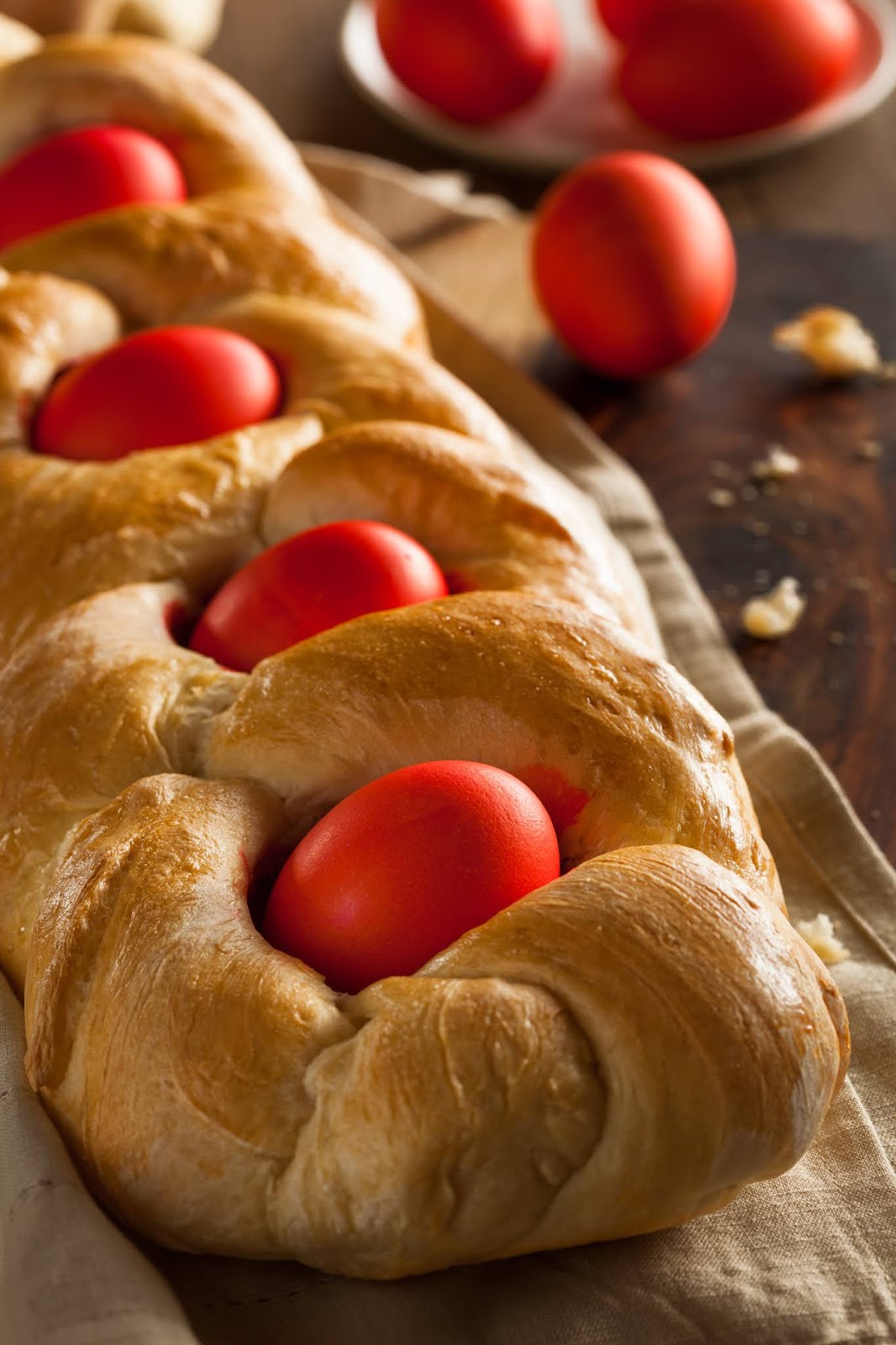
- Aggute - a traditional Greek-Calabrian Easter bread from the Bovesia region, it is prepared with a mixture of flour, eggs and butter and the surface is decorated with painted hard boiled eggs, similar to the Greek Tsoureki
- Scardateddhi - traditional Greek-Calabrian wedding sweets, made from flour, honey and anise seeds which are shaped like small doughnuts. They are then cooked in boiling water, and sprinkled with brown sugar before being served.
LINKS TO PREVIOUS POSTS ON GREECE
https://internationalfoodblog.blogspot.com/2017/01/international-greece-part-2-grikos.html
Wednesday, July 7, 2021
INTERNATIONAL GREECE: Part 2 - Griko cuisine merges with Italian cuisine
Greek presence in Italy begins with the migrations of the old Greek Diaspora (see world map below)
The darker the red in the photo above means the more Greeks in the area.
Dark Red: 1,000,000 or more
Next Red: 200,000 or more
Next Red: 50,000 to 100,000
Next Red: 20,000-50,000
Next: 1,000-20,000
Gray 1,000 or less
Greek Americans (Greek: Ελληνοαμερικάνοι, Ellinoamerikanoi) are Americans of full or partial Greek ancestry. About 1.3 million American people are of Greek descent, although there are estimates that raise this number to 3 million, and 321,144 people older than five spoke Greek at home in 2010.
During many centuries of cohabitation there was an exchange of knowledge between Griko and Southern Italians in the art of cooking. The Griko are traditionally producers of cereals, vegetables, olives and legumes. Local Griko cuisine does not differ greatly from the local Italian population, however there local regional variations. Many typical Griko dishes are still in use among them. Some of them are mentioned below.
Sadly the Grikos culture is disappearing as they meld with the Italians in Calabria and Apulia.
Pitta and Lestopitta - a traditional Greek-Calabrian
bread from the Bovesia region
Ciceri e ttrìa - A form of Tagliatelle served with chickpeas. Traditionally this dish was consumed on the feast of Saint Joseph on 19 March in Grecia Salentina.
- Cranu stompatu - a wheat dish, prepared in a simple way, by soaking and pounding the wheat
- ricchiteddhe - type of macaroni
- minchiarieddhi - a type of long macaroni
- sagne ncannulate - a wide tagliatelle up to inch and a half
- triddhi - irregular shaped pasta, specifically used for making Broth
- Ricchiteddhe cu lle rape - Orecchiette with turnip greens, a popular dish in Grecia Salentina
- Turcinieddhi - a type of tripe which includes grilled sheep innards
- Mendulata te cranu - a dessert similar to Pastiera, filled with cream cheese, honey, sugar and vanilla
- Le Cuddhure - a traditional Griko cake made during Easter, from the Greek Koulouri
Tiaulicchiu - Hot Chili peppers, extensively eaten throughout Grecia Salentina, they are usually stored dry, or preserved in jars of oil, with the addition of slivers of garlic, mint, and capers- Sceblasti - a traditional type of hand made bread from the Grecia Salentina region.
- Aggute - a traditional Greek-Calabrian Easter bread from the Bovesia region, it is prepared with a mixture of flour, eggs and butter and the surface is decorated with painted hard boiled eggs, similar to the Greek Tsoureki
- Scardateddhi - traditional Greek-Calabrian wedding sweets, made from flour, honey and anise seeds which are shaped like small doughnuts. They are then cooked in boiling water, and sprinkled with brown sugar before being served.
A book about the cuisine of the Griko of Salento has been published, entitled Grecia Salentina la Cultura Gastronomica. It features many traditional recipes distinctive to the Grecia Salentina region of southern Apulia.
----------------------------------------------------------------
LINK TO THE MYSTERIOUS PATMOS
LINK to A GLASS OF WINE AND A SHIBBOLEH FOR TRANSPLANTED PEOPLES
-------------------------------------------------------
Sunday, November 29, 2020
Saturday, November 28, 2020
INTERNATIONAL: BORDERLESS CUISINE 6 - A REVISIT TO GRIKO (ancient Greek civilization still existing in Puglia and Sicily) ITALY -
During many centuries of cohabitation there was an exchange of knowledge between Griko (transplanted Greeks) and Southern Italians in the art of cooking. The Griko are traditionally producers of cereals, vegetables, olives and legumes. Local Griko cuisine does not differ greatly from the local italian population, however there are local regional variations. Many typical Griko dishes that are still in use among them. Some of them are mentioned below.
Pitta and Lestopitta - a traditional Greek-Calabrian bread from the Bovesia region.
LINK to stuffed pitta recipe
Ciceri e ttrìa - A form of Tagliatelle served with Chickpeas. Traditionally this dish was consumed on the feast of Saint Joseph on 19 March in Grecia Salentina.
Cranu stompatu - a wheat dish, prepared in a simple way, by soaking and pounding the wheat
Tiaulicchiu - Hot Chili peppers, extensively eaten
throughout Grecia Salentina, they are usually stored dry, or preserved in jars of oil, with the addition of slivers of garlic, mint, and capers.
Sceblasti - a traditional type of hand made bread from the Grecia Salentina region.
Aggute - a traditional Greek-Calabrian Easter bread from the Bovesia region, it is prepared with a mixture of flour, eggs and butter and the surface is decrated with painted hard boiled eggs, similar to the Greek Tsoureki
Scardateddhi - traditional Greek-Calabrian wedding sweets, made from flour, honey and anise seeds which are shaped like small doughnuts. They are then cooked in boiling water, and sprinkled with brown sugar or iced with honey before being served.
A book about the cuisine of the Griko of Salento
has been published, entitled Grecia Salentina la
Cultura Gastronomica. It features many
traditional recipes distinctive to the Grecia
Salentina region of southern Apulia.
Above from WIKI
-----------------------------
LINKS TO PREVIOUS BORDERLESS CUISINE POSTS
LINK to Part 1 - Grits
Subscribe to:
Posts (Atom)