Translate

Showing posts with label Slovenia. Show all posts

Monday, July 25, 2022

INTERNATIONAL: BREAD OF THE WEEK 133 - GUBANA

International food blog: INTERNATIONAL: BREAD OF THE WEEK 133 - GUBANA: Easter and Christmas bread (some call it cake) but GOOD for any celebration!!!!!! LINK to Gubana Recipe   This bread is made in Venice 


INTERNATIONAL: BREAD OF THE WEEK 133 - ITALIAN GUBANA

 Easter and Christmas bread (some call it cake) but GOOD for any celebration!!!!!!


 This bread is  made in Venice (right near the Austrian and Slovenia and Croatian borders) and in Fruili-Venezia Giulia (Italy)


The Gubana is a brioche-style enriched dough flavoured with orange and vanilla with a filling containing nuts, raisins, cocoa, candied fruit and Grappa, Rum and Marsala. It is rolled like a Swiss Roll and then spiraled into a snail shell shape.
Also known as a Eastern European pastry as potica, kolachi, gubana or bejgli.


Tuesday, June 21, 2022

INTERNATIONAL: BORDERLESS CUISINE 27 - Friuli-Venezia Giulia (Itally)

INTERNATIONAL: BORDERLESS CUISINE 27 - Friuli-Ven...:   Friuli-Venezia Giulia lies on the northeastern edge of Italy bordered by Austria to the north, Slovenia to the east, the Adriatic Sea to t...


INTERNATIONAL: BORDERLESS CUISINE 27: Friuli-Venezia Giulia (ITALY)


Friuli-Venezia Giulia lies on the northeastern edge of Italy bordered by Austria to the north, Slovenia to the east, the Adriatic Sea to the south, and the Veneto to the west. Throughout history, the region’s neighbors took a stab at staking their claim to the territory. Consequently, the Austrians, Slavs, Venetians, and even the Romans left their indelible mark on Friuli’s culture, cuisine, and customs.

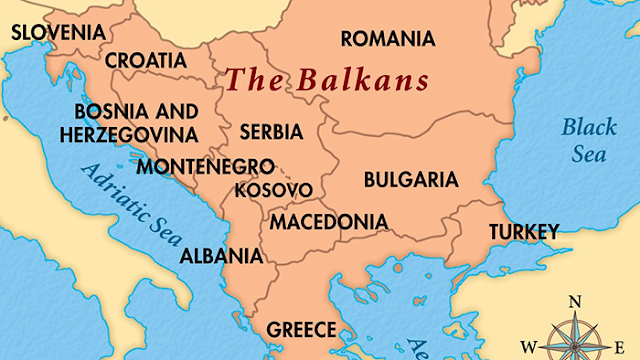
 With its origins in the Balkans, ajvar is a flavorful sauce made with charred red peppers, roasted eggplant, garlic, vinegar, and oil. The ingredients are blended to create a sauce used with sausages, cold meats, or salami in Friuli.

Map of the Balkans


Both sweet and savory versions of strucolo, Friuli’s take on Austrian strudel, are enjoyed in the region. In either case, strucolo features a roll of dough stuffed with some variation of filling. Savory strucolo is served as a primo piatto, or first course, and contains just about anything. Typical fillings include ricotta, spinach, peas, or minced veal, or beef. If not baked, strucolo are rolled, tied on the ends with thread, and boiled. They may be served seasoned with melted butter and breadcrumbs or cheese. In contrast, strucolo di pomi is a popular sweet version similar to apple strudel.


 Popular in Trieste, jota is a winter staple in Friulian cuisine, as this comforting stew of beans, potatoes, and tangy sauerkraut is ideal for warming up when temperatures drop. The beans and sauerkraut, known locally as capuzi garbi, are cooked with cumin, bay leaves, potatoes, and pancetta to make this thick soup. Jota exemplifies the Austrian influence on food in Friuli

Especially prominent in Trieste yet enjoyed throughout Friuli, gnocchi di prugne are plum-filled potato dumplings popular in regions once ruled by the Austro-Hungarian empire.

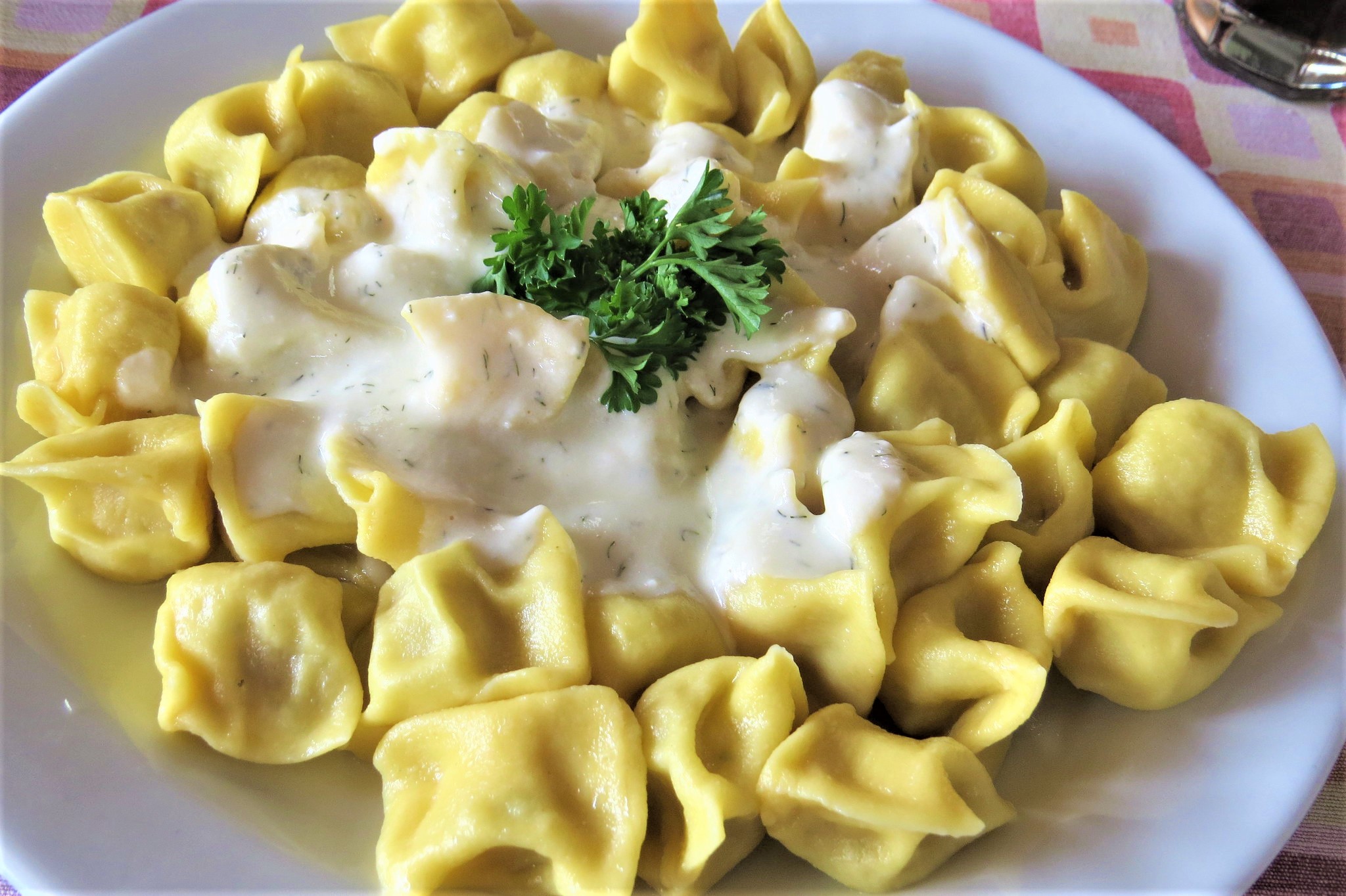
Also known as cialzons, cjarsons are a filled pasta resembling Italian ravioli.


I girini is a Friulian pasta made similarly as Austrian spätzle.

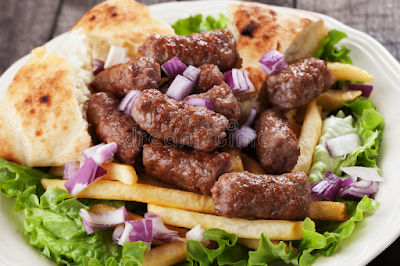
A Friulian specialty inherited from the Balkans, cevapčići are a cross between kebabs and sausages. They’re made from mixed minced beef and lamb meat, seasoned with garlic, onion, paprika, white wine, and olive oil. The latter of which helps the meat remain tender while grilling. Cevapcici is served with ajvar sauce for an authentic taste of the Balkans in Friuli. 


Adored in Trieste and Gorizia, presnitz is a coiled spiral of puff pastry dough filled with a mixture of dried fruits, nuts, citrus peel, cinnamon, and rum. It’s baked and then sprinkled with powdered sugar for a heartwarming dessert. Presnitz originally hails from a Slovenian town just over the border from Italy called Castagnevizza.


Goulash Triestino originates from Trieste, the capital of Friuli-Venezia Giulia, which was a part of the Austro-Hungarian Empire, and as a result, the goulash is made with Hungarian paprika, among other ingredients.


Paparot is a traditional Italian soup originating from the Friuli-Venezia Giulia region.


Friuli is a multicultural melting pot of Slavs, Austrians and Italians – the people of Friuli speak multiple languages, ranging from Venetian dialects in the south, Slovene and Bavarian in the north and the native Friulian dialect (as well as the official language of Italian).


Heavily influenced by nearby Austria, Slovenia and Croatia, Friuli is a fascinating confluence of culinary scenes – goulash is served with polenta, gnocchi are made with cherries and prunes and the most popular regional dish is jota – a stew made with sauerkraut, beans, potatoes and bacon. 


The first time you see brovada in Friuli Venezia Giulia, you might well mistake it for sauerkraut – although the two are different, it’s clear that brovada has its roots over the border in Austria. Whereas sauerkraut uses cabbage, brovada takes thin slices of turnip (or whole vegetables, as above) and macerates them in red wine vinegar and grape must, before cooking it all down with oil, bay leaves and a nice chunk of fatty pork.  Polenta has roots in the north and central Italy, as well as neighboring countries, such as Switzerland, Slovenia, and Croatia.


Try Friuli-Venezia Giulia for prosciutto di San Daniele.


What is Italian cuisine in Slovenia? Italian cuisine has particularly influenced the cuisine of Slovenian Istria, given the historical presence of local ethnic Italians (Istrian Italians), influence that has eased after the Istrian-Dalmatian exodus.


You’ll find that the region has just as much in common with neighboring Austria, Slovenia and nearby Croatia as it does with its homeland.

Centuries of Austrian rule have left an indelible mark on Friulian cuisine, in surprising and unsurprising ways. Friulians have a particular love for stereotypical Germanic cuisine – meat, potatoes and sauerkraut, for example – that doesn’t really exist in other parts of Italy.


The western world remains obsessed by European coffee culture, but that culture first started in Veneto and Friuli. Venice is widely regarded as the first port to start importing coffee into Italy, but the Friulian city of Trieste was just as important in the coffee trade – Vienna already had a significant coffee-drinking culture by the mid-seventeenth century, and all that coffee had to come through Trieste. The Austrian capital still has a reputation for outstanding coffee, but as a result, so does Trieste – the city is home to Illy Coffee, and the coffee bars are thriving hubs of activity throughout the day. Try a cappuccino Triestino while you’re there – it’s somewhat like a macchiato but with whipped cream instead of milk!

 Jota, however, is easily the most common soup – made from white sauerkraut, potatoes, beans and pork sausage, it couldn’t be more Austrian if it donned lederhosen and yodeled The Sound of Music from beginning to end. The thick texture and hearty ingredients make it perfect fare for bracing the bitter winds and colder temperature

Strucolo is Friuli’s take on the famous Austrian strudel, but they are much more versatile than their Germanic cousins. Savory strucolo often comes as a first course and can contain almost anything; ricotta, peas, spinach and veal mince are all common. Dried fruit and chocolate are common in sweet strucolo, although if you’re anywhere around Trieste you’ll likely find them stuffed with walnuts, breadcrumbs and raisins – a local delicacy. If they’re not baked, strucolo are sometimes wrapped and boiled – once cooked, they’re sliced and served with a good sprinkling of sugar and maybe even some whipped cream for extra decadence. You'll also find plenty of Friulian bakeries serving apple strudel; the quintessential dessert of the region.

Brovada is very typical of Friuli, and another great example of the region’s Austrian heritage. Turnips are cut into small slices or left whole and macerated in red wine vinegar and grape must before being cooked down very slowly in a pot with a splash of oil, bay leaves and a fatty piece of pork. The result turns out very much like sauerkraut – the vinegar pickles the turnips whilst they cook down, and the finished brovada is often served with muset – a large pork sausage made from pig snout that's similar to cotechino.

Stews are common in Friuli Venezia Giulia, and gulasch is especially popular in the winter. Though we typically associate gulasch (or goulash) with Hungary, Austria and Hungary have only been independent since the end of World War One, so they have a huge amount in common. Gulasch in Friuli is very similar to that you’d find further north – big chunks of melt-in-the-mouth, slow-cooked beef with lots of hot pepper and paprika. The Italian twist? Gulasch in Friuli is normally served with polenta – a staple all across the north of Italy.

Mainland cuisine is more characterized by the earlier Slavic and the more recent contacts with Hungarian and Turkish cuisine, using lard for cooking, and spices such as black pepper, paprika and garlic.[The coastal region bears the influences of the Greek and Roman cuisine, as well as of the later Mediterranean, in particular Italian (especially Venetian). Coastal cuisines use olive oill, herbs and spices such as rosemary, sage, bay leaf, oregano, marjoram, cinnamon, clove, nutmeg and lemon and orange rind. Peasant cooking traditions are based on imaginative variations of several basic ingredients (cereals, dairy products, meat, fish, vegetables, nuts) and cooking procedures (stewing, grilling, roasting, baking), while bourgeois cuisine involves more complicated procedures and use of selected herbs and spices. Charcuterie is part of the Croatian culinary tradition in all regions. Food and recipes from other former Yugoslav countries are also popular in Croatia.


Wednesday, November 18, 2020

INTERNATIONAL: BORDERLESS CUISINE 8 - Slovenia, Austria, Italy, Croatia and Hungary

At the bottom of the page are links to the first 8 "Borderless Cuisine" posts. 

-----------------------------

Slovenia, Austria, Italy, Croatia and Hungary

Local cuisine is under a considerable influence of the neighboring countries’ cuisines: Austria, Italy, Croatia and Hungary. Its basis are made up with cereals, dairy products, meat (especially pork), sea and fresh-water fish, vegetables, beans, olives and grape.


Slovenia has borrowed sausage from other countries.


Flancati or Pohanje - is a rough puff pastry. 

Wiener Schnitzel is a breaded veal dish from Austria and other countries.


and strudel from Austrian cuisine which is also prepared in Croatia, Slovenia, Italy and Hungary.


Among popular Italian dishes, which can be tasted in Slovenia, there are almost all kinds of dishes made from pasta (testenine),
potato dumplings called gnocchi,


with Video

Gnocchi are also eaten in Italy, Croatia, France, Poland, Slovenia and South America 
(several Italians settled in SA)


pizza (pica), risotto (rižota) and zlikrofi,
 which resemble ravioli.


LINK to Zlikrofi-dumplings recipe with step-by- step instructions

Hungarian cuisine has gifted the local one with goulash (golaz), braised chicken or beef (paprikas) 


and palacinke – thin pancakes which are filled with jam or nuts and chocolate is poured over them. 


Apple pie and meat double-cake (burek) relate to the main Balkan dishes.


--------------------------

LINK to Part 2  - Filled Pastries


Tuesday, April 23, 2019

INTERNATIONAL: BORDERLESS CUISINE 14 - Italian LINK to Former and Present Yugoslavia (Croatia and Slovenia): Recipes, Photos and VIDEO


INTERNATIONAL: BORDERLESS CUISINE 14 - Italian LINK to Former and Present Yugoslavia (Croatia and Slovenia): Recipes, Photos and VIDEOS

(Photos of Croatian and Slovenian
 Food below)


Above is map of former Yugoslavia

Italian is classified as an Indo-European language.  There are 55,000,000 speakers of Italian in Italy. These include individuals who are bilingual in Italian and regional varieties as well as those for whom Italian is a second language. There are an additional 6,500,000 plus speakers of Italian in other countries.

I bet you didn't know the following facts:
These countries have Italian dialects:
Argentina, Australia, Belgium, Bosnia and Herzegovina, Brazil, Canada, Croatia, Egypt, Eritrea, France, Germany, Israel, Libya, Liechtenstein, Luxembourg, Paraguay, Philippines, Puerto Rico, Romania, San Marino, Saudi Arabia, Slovenia, Switzerland, Tunisia, United Arab Emirates, United Kingdom, Uruguay, USA, Vatican State.

Italian is also recognized as an official language in Croatia, San Marino, Slovenia, and Switzerland.
I have addressed Croatia and Slovenia in this post. 

Italian language spoken in Croatia LINK below:


This map shows the percentages of Italians in municipalities of Istria in 1910, based on the Austro-Hungarian census. Italians made up more than 70% of the population in 43 areas.
Darker colored areas speak the most Italian.


Historically, the language had a much larger population than it does now. Italians have lived on the Adriatic coast for hundreds of years, and Istria was part of the Kingdom of Italy from 1919 until 1947. 

The 2011 census in Croatia

 reported 17,807, or 0.42% of the total Croatian population, mostly in Istria.  Istria Ethnologue reported 70,000 speakers in 1998: 40,000 ethnic Italians and 30,000 ethnic  Croats and Istrian people.  Native Italian speakers are largely concentrated along the Adriatic coast. In addition, roughly 120,000 Italian tourists visit Croatia each year, so many in the service and tourist industries have some knowledge of the language.

However the Istrian exodus after the Second World War and Yugoslavian ethnic cleansing in the form of the Foibe massacres forced the greater part of the Istrian Italians to flee to Italy. During the Italian exodus, about 350000 people left Istria, Dalmatia and the isles of Croatia.


LINK TO traditional Croatian baked strukli
 and step-by-step directions


------------------------------------------------------


Photos of Croatian Foods


Croatian Food Video Link Below

-----------------------------------------

Photos of Slovenian Foods


Slovenian Food Video Link Below

https://www.youtube.com/watch?v=4bus13fCvCg&ab_channel=EUROTROTTER
ER

----------------------------------------
Links to previous "Borderless Cuisine" posts